1. Hua Tuo
Hua Tuo was an ancient Chinese physician who lived during the late Han Dynasty and Three Kingdoms era. He was born inBozhou, Anhui.Bozhou is one of the four cities of medicine in China.
Hua Tuo was born into a poor family. When he was seven years old, his father passed away, taking with him the only source of family income. Faced with financial hardship and poverty, Hua Tuo began to work in a local herbal pharmacy.While working there, he carefully observed the practice of medicine and pharmacy. Thus began his careerasone of the best physicians.
Hua Tuo practiced medicine during the end of the Eastern Han and beginning of the Three Kingdoms, a period of time characterized by political instability with constant battles and turmoil. He sympathized with the common people whose lives were suppressed by the government and dedicated his entire life to helping them. Therefore, he was also known as “the physician of the people”. He preferred to treat the common folks and repeatedly refused to accept offers of the position as the Supreme Physician in the Imperial Palace.
Hua Tuo is respected for being the first surgeon and inventor of Mafeisan (Numbing and Boiling Powder), an herbal formula used tostoppatientsfeelingpainduring a surgeryin TCM. He believed that for diseases that could not be treated with acupuncture and herbs, the only solution was surgery to remove the cause. It is well-documented that Hua Tuo frequently performed surgery on various parts of the body by using Mafeisan for systemic anesthesia.
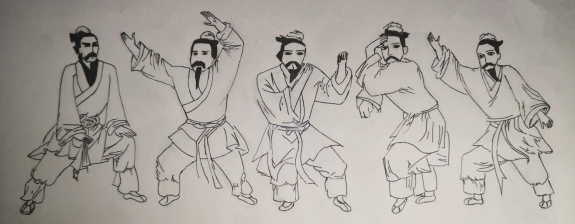
Despite his outstanding achievements, there were always more patients than Hua Tuo could possibly care for in his practice. Thus, he began to wonder why people were always sick and what would make them healthier. Hebelieved that chronic illnesses were due, in part, to a lack of physical activity and proposed regular exercise as a remedy. As part of Hua Tuo's strong emphasis on the importance of physical activity, he developed Wuqinxi (Five Animal Frolics), an exercise that imitates the physical movement of tigers, deer, apes, bears and cranes.
 Of the stories told of Hua Tuo, one legend is that General Guan Yu, one of the great military heroes of the time who eventually became the god of war, came to Hua Tuo because of an arrow wound in his arm that had become badly infected. The surgeon prepared to give his patient the usual anesthetic drink, but General Guan Yu laughed scornfully and called for a board and stones for a game of go. While Hua Tuo scraped the flesh and bone free of infection and repaired the wound, Guan Yu and one of his military companions proceeded calmly with their game.
In his later years, Hua Tuo was called by the emperor of the Wei Kingdom, Cao Cao, to treat his “head wind” (presumably migraine headache) that had not responded to any of the treatments by many other physicians. By the insertion of just one needle, the chronic headache was alleviated. Cao was so impressed he insisted on having Hua Tuo as his personal physician. However, Hua Tuo tactfully refused, claiming he needed to return home to attend to his sick wife.
Shortly after returning home, he was called again and subsequently forced by Cao to return to the Imperial Palace. Cao had another severe headache and wanted Hua Tuo to cure him and would not let him leave the Imperial Palace. Hua Tuo stated the headache was so severe it could not be treated simply with herbs or acupuncture. The only cure would be to induce anesthesia and surgically open the head to remove the cause of the headache. Cao thought Hua Tuo was making an attempt to assassinate him and sentenced Hua Tuo to death.
While in prison, Hua Tuo compiled all of his clinical experience in writing and tried to give it to a prison guard for safe keeping. However, out of fear of Cao, the guard refused to do any favors or accept anything from Hua Tuo. In extreme anger and frustration, Hua Tuo burned his manuscripts, turning all his clinical knowledge to ashes. After Hua Tuo died, he was buried next to a flowing river of clear water---symbolizing he was cleared from all wrong-doing.
2.Zhang Zhongjing
Zhang Zhongjing (AD 150-219), commonly known as Zhang Ji, was a famous physician from the Eastern Han Dynasty. He was known for his bookShang Han Za Bing Lun(《伤寒杂病论》Treatise on Cold Pathogenic and Miscellaneous Disease), which was the most influential and impactful medical book in the development of Chinese medicine. It was also the first monumental work on clinical medical treatment in China. This book effectively developed and established the theoretical framework for Chinese medical diagnoses and treatment. His book is highly regarded by doctors of all ages, and he is admired as the Saint of Medicine.
Zhang Zhongjing was born in Nanyang, Henan Province. His home townwasone of the four cities of medicine in China. While still a young man, Zhang Zhongjing took a special interest in medicine. In his time many people were infected with febrile disease, as was his own family. He learned medicine by studying from Zhang Bozu, a fellow townsman,from other carefully-studied medicinal texts, and by accumulating prescriptions from around China.
When Zhang Zhongjing was a prefect of Changsha, disease prevailed in the country. As medicine was not very developed then, many people, especially the poor, turned to witchcraft when they were sick, only turned out to be cheated. Zhang Zhongjing was truly upset with what he observed. He hated the shamans, who brought death upon the people for money.
Once he saw a woman suffering because of her illness. She was crying and laughing, obviously under some form of stimulation. Zhang Zhongjing took a closer look at the patient and pointed out that she was in fact suffering from internal heat in her blood chamber, which could be cured. He applied acupuncture to the patient, who healed after a few days.
One day Zhang Zhongjing, while working asaphysician, saw a group of people gathered in front of a house. He went forward to examinethesituation. A man was lying on the floor with a few women crying next to him. Zhang Zhongjing was told that the man had hanged himself because he was too poor to continue living. Zhang kepttheman warm by covering him with a blanket. Then he asked two men to press on the man's chest while moving his two hands. Zhang Zhongjing then exerted pressure with his palms on the man’s abdomen and waist a few times. After a while, the man came around.
Zhang's masterpiece,ShangHan ZaBing Lun, was collected and organized later by physicians, notably Wang Shuhe from the Jin Dynasty and various court physicians during the Song Dynasty into two books, namely for the former,Shanghan Lun(《伤寒论》Treatise on Cold Pathogenic Diseases), which was mainly on a discourse on how to treat epidemic infectious diseases causing fevers prevalent during his era, and the latter, a highly influential doctrineJinGui YaoLue(《金匮要略》Synopsis of Golden Chamber), a compendium of various clinical experiences which was regarded as a main discourse on internal diseases. These two texts have been heavily reconstructed several times up to the modern era.
3.Sun Simiao
Sun Simiao (581-682) was the greatest doctor in the Tang Dynasty. When he was young, Sun Simiao was very intelligent but frequently suffered from diseases. He was well educated and read books of various schools, including medicine. Twoemperors of the Tangdynasty invited him to work in the Imperial Court, but he refused to accept. All through his life, he lived in the mountains, practiced and studied medicine. He lived for over one hundred years and was worshiped asKing ofMedicine.
Sun Simiao wrote two books,QianJin YaoFang(《千金要方》Golden Prescriptions)andQianjin Yifang(《千金翼方》Supplement to Golden Prescriptions), thirty volumes each. These two books contained 6,500 prescriptions and covered the aspects of life cultivation, acupuncture, moxibustion, medicines and other related fields. SoQianJin YaoFangwas both a comprehensive book of medicine and an encyclopedia of medicine.
Qian Jin YaoFangwas different from other medical books in content arrangement. For instance, he put the part about prevention and treatment of women diseases during pregnancy and nursing of the newborn at the beginning of the first volume. Such an arrangement may indicate that Sun Simiao respected women or advocated the concept of protecting and caring life from birth.
Besides, Sun Simiao also discussed extensively about doctors should cultivate their mind. He said a doctor should be well learntandhard working; regard patients as his relatives, avoid being self-proud and never slander other doctors. He wrote an article about the morality for doctors known asDaYi JingCheng(《大医精诚》On the Absolute Sincerity of Great Physicians)which wassogreat and importantthat was often called“the Chinese Hippocratic Oath”.
Sun Simiao died in AD 682. He is treated respectfully by later generations. People built temples, carved statues and built up public image for him. His books are widely printed and spread overseas, becoming important TCM works.
4.Li Shizhen
Li Shizhen (1518–1593)was a famous medical scholar who has sort of the same stature as Leonardo da Vinci in the West. He was born in Hubei in 1518 at a time of relative prosperity in the middle of the Ming era.
He is mainly known for laboring for most of his life on medical treatises and for publishing a very long encyclopedia of natural medicine calledBenCao GangMu(《本草纲目》Compendium of Materia Medica).The text is highly detailed and organized, and it is the product of decades of study of rare books and medical texts. He added his own understanding derived from his own medical practice and his family’s medical lore. He went on journeys for research and to interview practitioners.
Both Li Shizhen’s father and grandfather were doctors, and he grew up helping his father in his practice. Li's grandfather was a wondering country doctor who went around with a bag of herbs and medications and healed people. His father was a doctor and a scholar who had written several books. He wanted his son to enter the government by passing the Imperial Examinations. Li studied for the exams and passed the country-level examination, but he was never able to pass the Imperial Examination.
When he was 27, he cured the son of a prince and was invited to be a doctor and official in that court. A few years later, he became an official at the Imperial Medical Institute in Beijing. During the year he spent there, he had access to rare and old medical texts. He also saw that the available medical texts had inaccuracies and contradicted each other and that the medical knowledge of his time was not well defined. He wanted to compile correct information in a logical system of organization.
He wanted to survey all the available knowledge of his time and write the most accurate natural medical text ever written. He thought that the medical texts that were generally available were inaccurate and even had dangerous misinformation. He is thought of as a man who dedicated his life to write a text to help people.
To research for his book, he travelled extensively and gained first-hand experience with many herbs and regional folk remedies, and he consulted hundreds of books. He worked on the text for decades and tried to have it published both by a private printer and by the court.
His book was made so finely detailed and listed so many different herbs, medicinal minerals and medicinal animal parts that his book was very long and too big and heavy to be used by travelling doctors. The text was divided into many volumes. In his drive for accuracy and completeness, a lot of the material was not useful for average practitioners, though it is useful for scholarly reference. It includes material on his understanding of geology, physics and other topics. It is also useful because he included a very long list of references.BenCao Gang Muis considered the greatest scientific achievement of the Ming era.
转载自《中医药文化概览》
